
(composing on the grid pt.i) Listening Without Arrival
On attention as inhabitation · HTL-01

Rather than analysing existing music, this essay documents the construction of a piece written inside a specific behavioural region. The conditions for writing it were fixed first. The music followed.
These cards were drawn before composition began. Each imposed conditions on the piece — constraints on harmony, form, movement, and attention. They appear throughout the essay where those conditions become music.
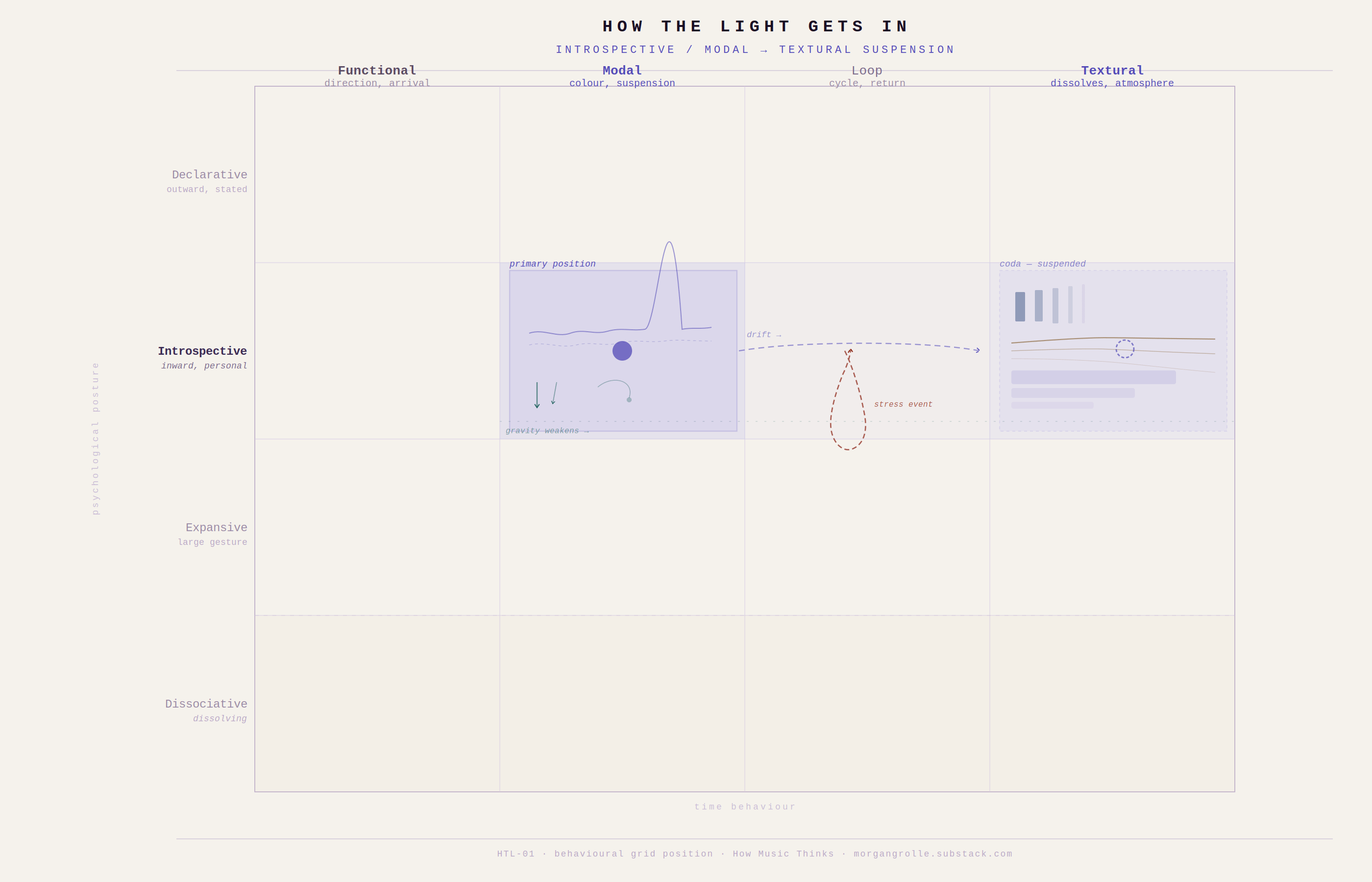
Behavioural Position
Introspective / Modal · gradual drift toward Textural suspension
Harmonic gravity: softened · Cadential force: withheld · Temporal mode: atmospheric
Most listening is a form of navigation. There is somewhere to go. The music establishes a gravitational field — a tonic, a rhythm, a structural promise — and then moves through time in relation to that promise. Tension accumulates. Release is anticipated. The ear leans forward, oriented by expectation, measuring its progress through the piece against the promise of arrival. This is one of music’s central achievements: the organisation of time into felt direction.
But direction is not the only thing attention can do.
Card Draw // Archetype
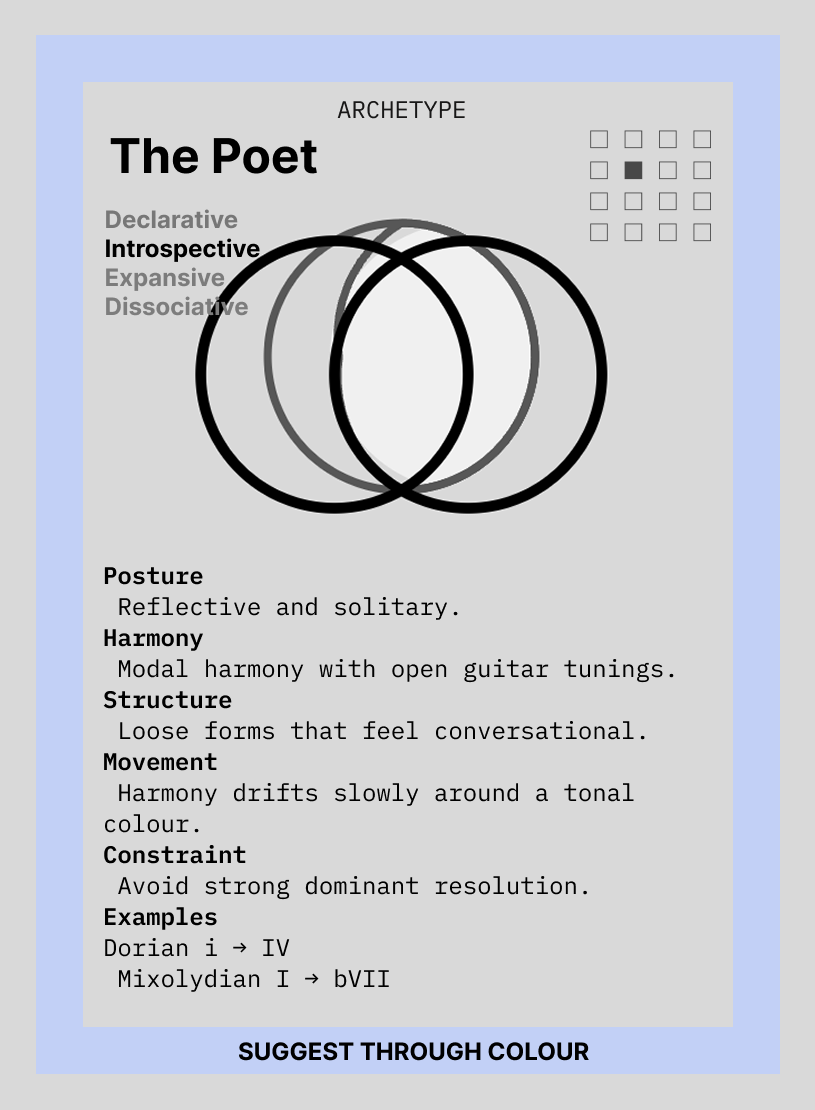
There is a different listening condition that certain music creates. It is the state that emerges when arrival softens without disappearing entirely. When harmonic movement continues but loses its rhetorical urgency. When pulse exists but stops driving. When the music implies centres rather than insisting upon them. Under these conditions, the forward lean of attention gradually releases. The ear stops moving toward something and begins, almost without noticing, to move inside something.
The shift has a precise harmonic cause. Functional harmony is directional because its chords carry gravitational weight — a dominant wants to resolve, a leading tone wants to rise. These forces accumulate pressure and discharge it. The ear learns to anticipate discharge points. Form becomes the pattern of accumulation and release across time.
Modal harmony weakens this without abandoning pitch organisation entirely. The dominant loses its urgency. The tonic becomes less a target and more a region. Chords continue to change, but the changes alter the atmosphere more than they alter the direction of travel.
Card Draw // Time
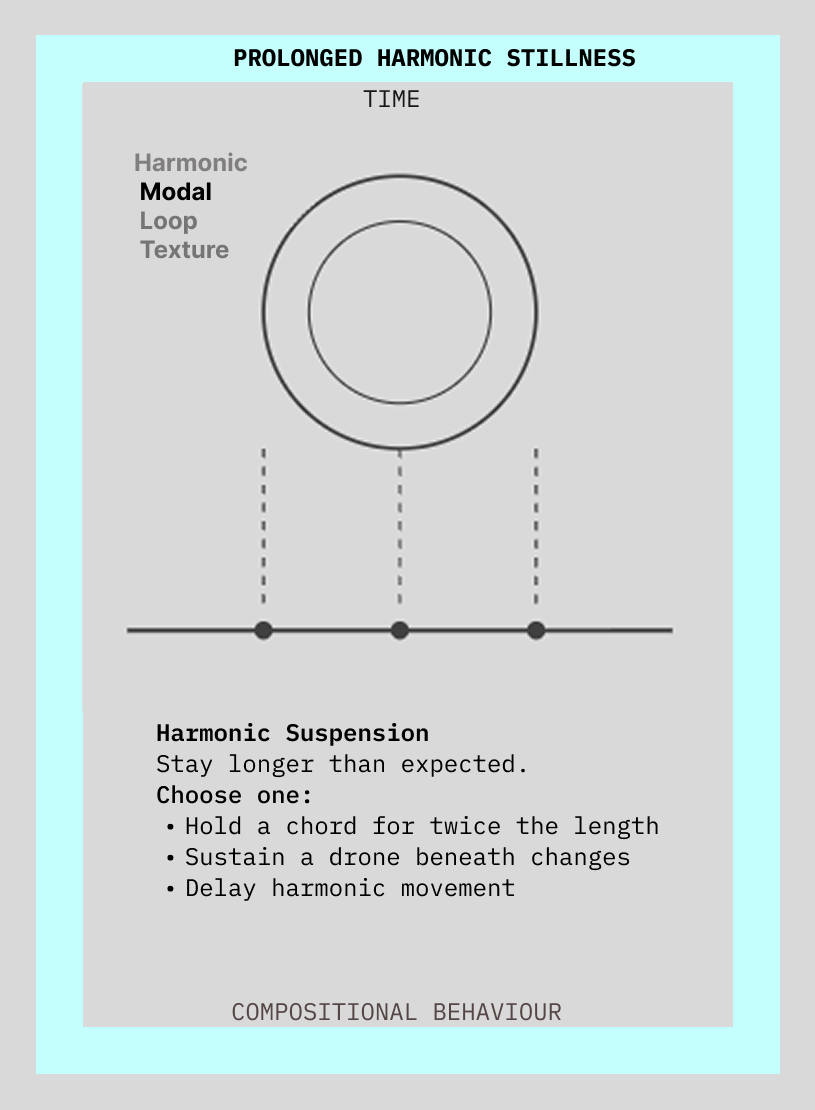
What felt like withholding gradually reveals itself as the territory. At first, the ear experiences this as delay. But delay implies an object being delayed toward — and gradually that object reveals itself as absent. There is only continued presence. The ear adjusts. It stops waiting. It begins to inhabit.
Behavioural Grid · Attention Modes
Functional
Directional attention — navigation through time
Modal
Environmental attention — sustained inside a field
Loop
Cyclical attention — return as structural logic
Textural
Distributed attention — no foreground, only field
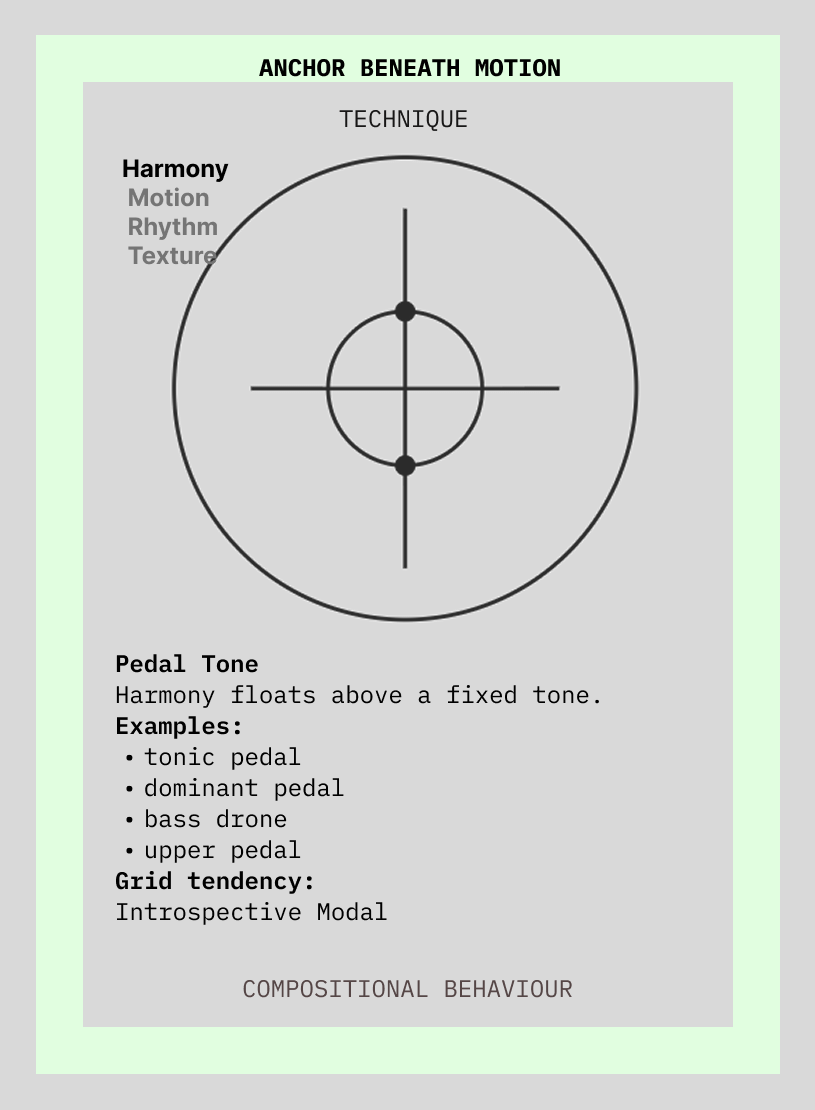
Card Draw // Technique
This is where listening begins to acquire some of memory’s qualities.
When a piece of music revisits a gesture without developing it, or a melodic fragment recurs slightly altered — too subtle to feel like variation and too present to feel like repetition — the listener can experience a kind of familiarity. Recognition without origin. Familiarity without sequence. The sense of having been here before without being able to locate when the first time was.
This kind of listening emerges naturally once arrival weakens and pulse softens. Without the anchoring provided by strong cadential events, temporal position becomes less certain. Earlier material and present material begin to occupy a shared atmospheric space. The music stops feeling like it is moving from a past into a future and starts feeling like it is simply — and wholly — present.
Gradually, the listener’s relationship to time itself begins to change. The question of where we are in the piece — how far through, how close to the end — gradually stops feeling relevant. There is no structural clock still running. There is only the current atmosphere and the slowly accumulating sense that it has always been here, that it was here before the piece started and will remain after it ends. Memory and anticipation collapse into a single sustained now.
Conditions this delicate are also vulnerable.
Card Draw // Disturbance
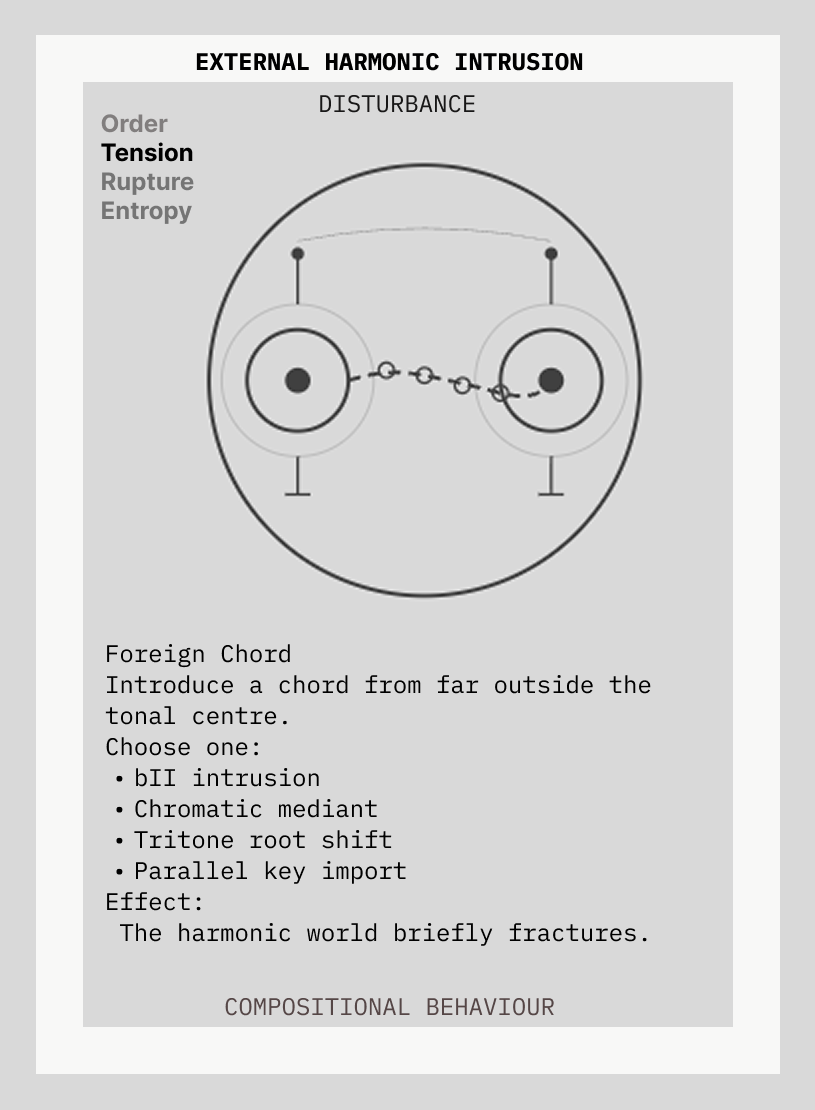
The disturbance matters because inhabitation is not passivity. The listening state described above is active — it requires the continuous maintenance of a field, which means it can be broken. When something arrives from outside the harmonic world the piece has built, the listener suddenly feels how fragile the atmosphere actually was. The fracture is brief. The field recovers. But the recovery is felt as recovery — which means the listener now knows they were somewhere, that the somewhere was real, that it could have been lost.
Under these conditions the piece gradually stopped behaving like an object moving through time and became an environment sustained through time.
The music ends. The atmosphere takes slightly longer to notice.
The Piece
How The Light Gets In
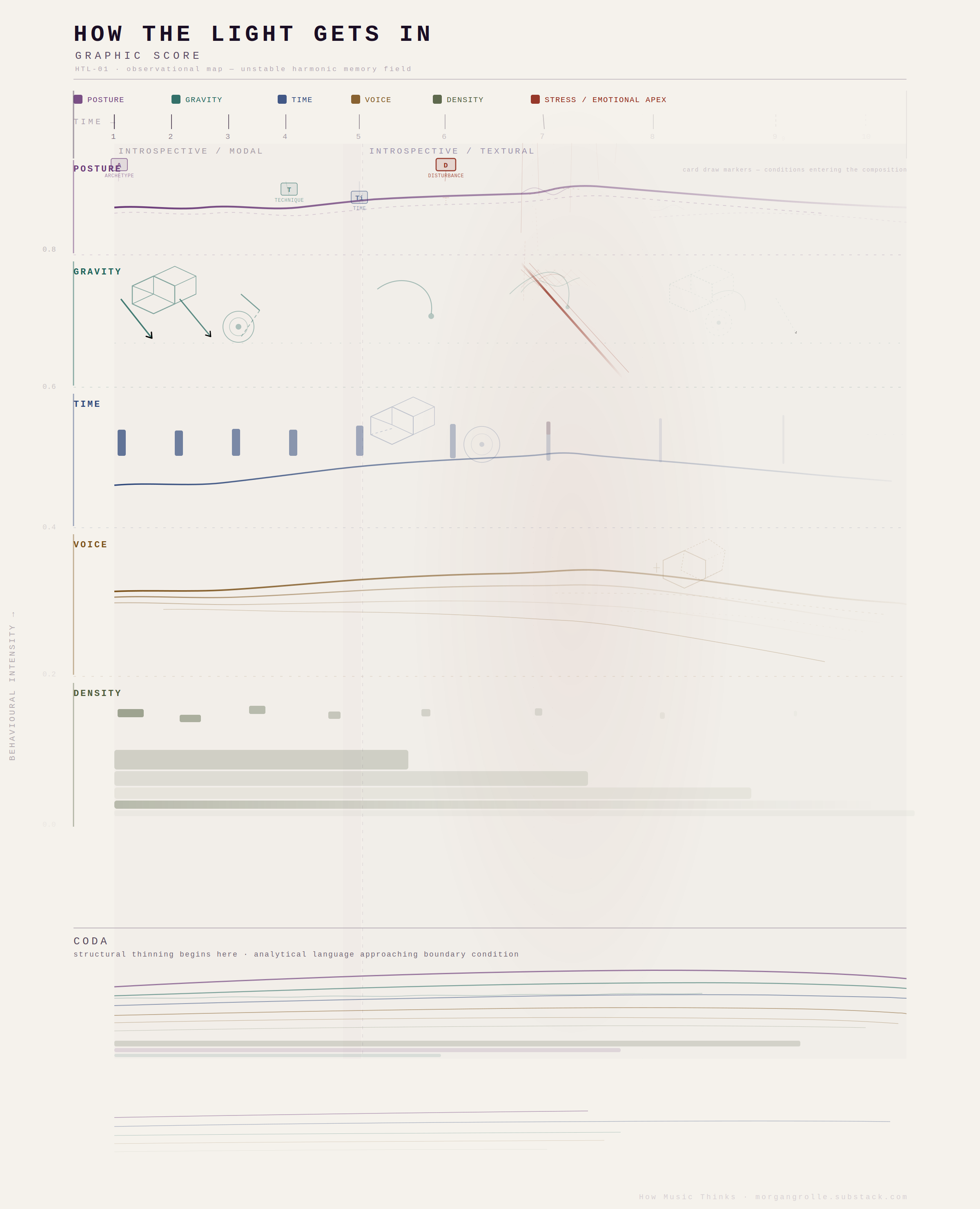
The following piece was written under these conditions.
Graphic Score · HTL-01
This is fascinating. "This is where listening begins to acquire some of memory’s qualities. When a piece of music revisits a gesture without developing it, or a melodic fragment recurs slightly altered — too subtle to feel like variation and too present to feel like repetition — the listener can experience a kind of familiarity. Recognition without origin. Familiarity without sequence. The sense of having been here before without being able to locate when the first time was." Going to chew on this a while. Thank you!!
I'm so curious how you came up with your visualization language. And simultaneously impressed with how you've made music visible